
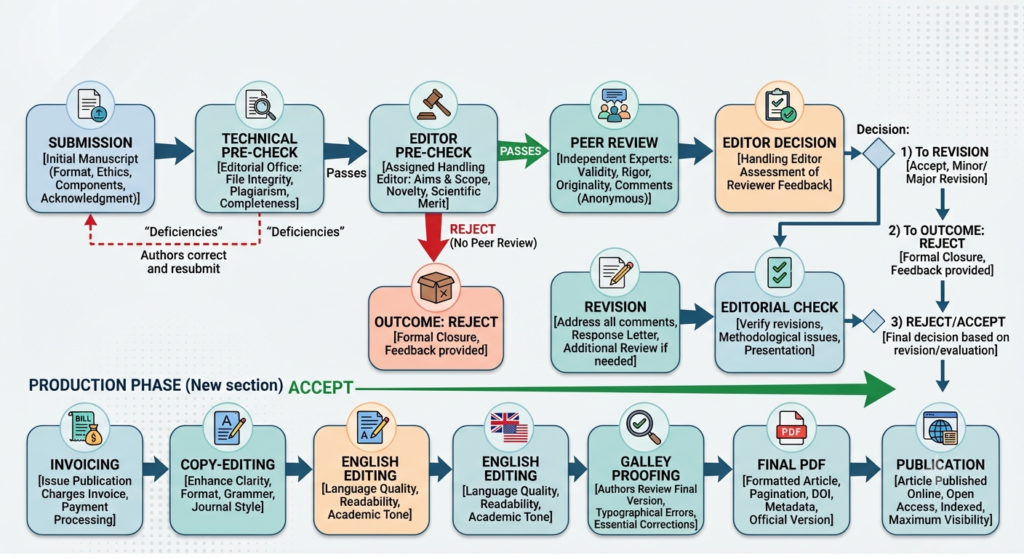
The editorial workflow of Integrative Bioscience Nexus is structured to ensure rigorous scientific evaluation, transparency, ethical compliance, and high-quality publication standards. The process is designed to support authors at every stage while maintaining the integrity and reliability of the scholarly record. It proceeds through a series of clearly defined steps from submission to final publication.
Submission
Manuscripts are submitted through the journal’s official submission system or designated editorial email. Authors are required to ensure that their submission complies with the journal’s formatting guidelines, ethical standards, and reporting requirements. Essential components such as title, abstract, keywords, main text, figures, tables, and references must be included at the time of submission. Upon successful submission, the corresponding author and co-authors receive an automated acknowledgment confirming receipt of the manuscript. The submission is then logged into the editorial management system, where it is assigned a unique manuscript identification number for tracking throughout the review process.
Technical pre-check
The technical pre-check is conducted by the editorial office to ensure that the manuscript meets basic submission requirements. This includes verification of file integrity, formatting consistency, figure resolution, reference style accuracy, and completeness of required sections. The manuscript is also screened using plagiarism detection software to ensure originality and compliance with ethical publishing standards. If deficiencies are identified, the manuscript may be returned to the authors for correction before entering the editorial review pipeline. This step helps streamline the subsequent review process by ensuring that only properly prepared manuscripts proceed further.
Editor pre-check
During the editor pre-check stage, the manuscript is evaluated by an assigned handling editor to determine its suitability for the journal. The editor assesses whether the manuscript aligns with the journal’s aims and scope and whether it presents sufficient novelty, scientific merit, and relevance to the field. At this stage, manuscripts with fundamental scientific flaws, insufficient originality, or lack of relevance may be rejected without external peer review. This initial screening ensures efficient use of reviewer resources and maintains the scientific quality of submissions entering peer review.
Peer review
Manuscripts that pass the initial editorial screening are sent for rigorous peer review. Independent experts in the relevant field are invited to evaluate the manuscript’s scientific validity, methodological rigor, originality, clarity, and contribution to the field. Reviewers provide detailed, constructive comments and recommendations aimed at improving the manuscript. The system ensures that both authors and reviewers remain anonymous, promoting unbiased and objective evaluation. Depending on complexity, multiple reviewers may be assigned, and additional review rounds may be conducted if required.
Editor decision
After receiving reviewer reports, the handling editor carefully evaluates all feedback and forms an independent assessment of the manuscript. The editor considers the strengths and weaknesses identified by reviewers as well as the overall scientific contribution of the work. Based on this evaluation, the editor issues one of several decisions, including acceptance, minor revision, major revision, or rejection. The decision letter is accompanied by anonymized reviewer comments to guide the authors in improving their work.
Revision
When revisions are requested, authors are expected to address each reviewer and editor comment systematically and thoroughly. A detailed response letter must be submitted, explaining how each issue has been resolved or providing justification when changes are not made. Revised manuscripts may undergo additional rounds of review depending on the extent of modifications required. The revision stage is critical for enhancing the scientific robustness, clarity, and overall quality of the manuscript.
Editorial check
After revision, the manuscript is reassessed by the editorial team to ensure that all concerns have been adequately addressed. The editor verifies that methodological issues have been corrected, interpretations are supported by data, and presentation standards are met. If necessary, the manuscript may be returned to authors for further clarification or additional revision. This stage ensures that the manuscript is fully aligned with the journal’s publication standards before final acceptance.
Reject/Accept
Following completion of the revision and editorial evaluation stages, the manuscript is either accepted or rejected. Acceptance indicates that the manuscript meets the journal’s scientific and editorial standards and is suitable for publication. Rejected manuscripts are formally closed with constructive feedback provided to assist authors in improving their work for submission elsewhere or future resubmission. Accepted manuscripts proceed to the production stage.
Invoicing
For applicable manuscripts, an invoice detailing publication charges is issued to the corresponding author or institution. The invoice includes clear information regarding fees, payment instructions, and deadlines. Payment processing is required to complete the publication workflow where applicable. The journal maintains transparency in all financial transactions related to publication services.
Copy-editing
Accepted manuscripts undergo professional copy-editing to enhance clarity, consistency, and formatting accuracy. Editors ensure that the manuscript adheres to the journal’s style guide, including citation format, heading structure, and overall presentation. This process also involves correcting grammatical inconsistencies, improving sentence structure, and ensuring logical flow without altering the scientific meaning. Copy-editing ensures that the manuscript is polished and publication-ready.
English editing
All accepted manuscripts undergo detailed language editing to ensure high linguistic quality and readability. This includes correction of grammar, syntax, punctuation, and academic tone to meet international publishing standards. The goal of English editing is to improve clarity and readability while preserving the author’s original scientific intent. This step is particularly important for ensuring accessibility to global readership.
Galley proofing
After editing, the manuscript is formatted into a galley proof and sent to the corresponding author and co-authors for final review. Authors are required to carefully check the proof for typographical errors, formatting inconsistencies, figure placement, and any minor inaccuracies. This is the final opportunity for authors to make corrections before publication. Only essential corrections are permitted at this stage to avoid delays in the publication schedule.
Final PDF
Once galley proofs are approved, the manuscript is finalized into a publication-ready PDF version. This document represents the official version of record and includes final formatting, pagination, DOI assignment, and publication metadata. The final PDF is archived and prepared for online dissemination. It ensures long-term accessibility and citation stability across indexing platforms.
Publication
After completion of all editorial, production, and financial processes, the article is formally published online in Integrative Bioscience Nexus. The published version is immediately accessible under open-access terms and is freely available to readers worldwide. Published articles are indexed where applicable and disseminated through multiple academic platforms to ensure maximum visibility and impact. The journal ensures long-term preservation and accessibility of all published content.